The Rise of Rooftop Dining in London
Something shifted in London around the mid-2010s. Hotel terraces had always existed, tucked behind members-only doors at places like Shoreditch House or the Coq d'Argent, but most Londoners never saw the inside of them. Then, gradually, that changed.
Casual dining culture had a lot to do with it. As the city moved away from formal restaurant experiences toward sharing plates, street food, and after-work drinks that stretched into dinner, outdoor spaces started making more sense. A rooftop suited the mood perfectly. Relaxed, social, no dress code.
Developers and landlords noticed that upper floors and flat rooftops were sitting empty above retail units, car parks, and converted warehouses. Turning them into bars and restaurants made commercial sense, and venues like Netil360 in Hackney or Bussey Building in Peckham showed that the appetite was real.
There's no denying that skyline views played a part too. London's skyline changed dramatically between 2010 and 2020, and watching the Shard or the Gherkin catch the evening light became its own kind of attraction.
By the early 2020s, rooftop dining wasn't a novelty anymore. It had become part of how the city socialises from April through September, built into the rhythm of the warmer months the same way Christmas markets own December.
How Pop-Up Food Venues Turn Unused Urban Space Into Social Hotspots
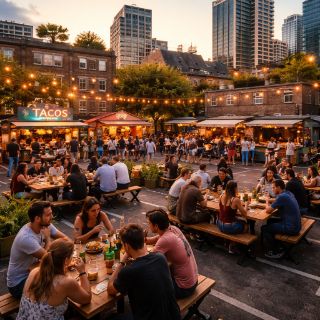
Empty car parks, decommissioned office rooftops, and scrubby gaps between mixed-use developments – London has always had more overlooked space than it knows what to do with. Pop-up food venues spotted that opportunity years ago, and the city hasn't looked back.
The model works because it's low-commitment on every side. Traders avoid the crushing overheads of a permanent site. Landlords generate income from roofs and terraces that would otherwise sit dormant. Diners get something that feels genuinely new rather than another chain opening.
Street-food kitchens like those at Peckham's Bussey Building or Hackney's Netil Market proved that a cluster of independent traders sharing a courtyard or rooftop can pull serious crowds without a single fixed restaurant. The setup is deliberately scrappy. Mismatched seating, rotating menus, fairy lights strung between shipping containers – it signals that the rules are looser here.
That relaxed energy is part of the appeal. There's no dress code, no waiter hovering, and no pressure to order three courses. You grab a natural wine, queue for a Korean fried chicken wrap, and share a table with strangers. Neighborhoods like Bermondsey and Dalston have used exactly this format to activate streets and rooftops that sat ignored for years, without waiting for large-scale redevelopment to arrive.
What Makes Rooftop Social Spaces Feel Different
There's something about being thirty feet above street level that changes how people behave. The noise drops slightly, the horizon opens up, and suddenly a Tuesday evening feels like an occasion.
Shared tables do a lot of the heavy lifting here. Unlike a conventional restaurant where each party stays in its own bubble, rooftop venues tend to seat people closer together, often at long benches or communal setups. Strangers end up sharing condiments, swapping recommendations, occasionally talking. It's informal in a way that indoor dining rooms rarely manage.
Timing matters too. Sunset at a rooftop bar in Peckham or Shoreditch isn't just atmospheric, it's practically a social event in itself. People plan around it. Groups arrive early to claim the best angle, and the whole mood shifts as the light changes. No restaurant with a ceiling can replicate that.
For groups, these spaces tend to work brilliantly. Walk-in energy, background music pitched at conversation level, and no pressure to order a three-course meal makes them genuinely flexible. A date night, a birthday drinks situation, a post-work gathering – rooftops absorb all of it without feeling awkward.
That blurring of restaurant and bar is exactly the appeal. You might arrive for a drink and stay for food, or skip dinner entirely and just graze. The format is loose by design, and most people seem to prefer it that way.
Seasonal Design, Rotating Menus, and the Rules That Keep It Working
Rooftop dining in London depends on more than a good view. Weather, licensing rules, kitchen planning, and changing customer habits all shape how these spaces are designed and operated throughout the year. Seasonal menus and flexible layouts help venues stay practical without losing the atmosphere that makes rooftop settings distinctive.
Covered terraces, overhead heaters, and retractable canopies have quietly extended the rooftop season well beyond the warmest months.
Designing for a City That Rains
Covered terraces, overhead heaters, and retractable canopies have quietly extended the rooftop season well past September. Venues like Netil360 in Hackney and Pergola Paddington run into late autumn precisely because they planned for it. Wind baffles, side screens, and blanket stations aren't afterthoughts. They're what separates a space that works eight months a year from one that closes when August ends.
Rotating Traders and Shared Kitchens
Guest traders keep food menus from going stale. Rather than locking in a single kitchen, many rooftops rotate independent chefs every few weeks or bring in weekend-only pop-ups. It keeps regulars coming back and gives small operators a platform without the overhead of a permanent site. Some venues run a different trader every Friday night. That low-commitment model works for everyone.
Licensing, Noise, and Staying Welcome
There's no denying that rooftops create friction with neighbours when they get it wrong. Licensing conditions typically cap music at specific decibel levels and set hard closing times, often 10pm for outdoor areas. Crowd flow matters too. A poorly designed entry point causes bottlenecks that raise safety risks and complaints simultaneously.
Accessibility is the part venues still struggle with most. Lifts, step-free routes, and accessible seating aren't optional extras if a space wants to serve the whole city.
London's Best Nights Out Are Often Above Street Level
Somewhere between a rooftop bar in Peckham and a covered terrace in Shoreditch, you start to understand what makes this city tick. These spaces work because they bring together seasonality, spontaneity, and a genuine talent for squeezing life out of overlooked urban corners. Pop-up culture keeps the menus rotating and the crowds returning. Shared tables and street-food kitchens strip away the formality and make eating out feel social again. Thoughtful design handles the weather, and responsible operators handle the noise and access. The best rooftop venues aren't popular simply because they offer a skyline view – they're popular because they reflect exactly how London likes to spend an evening: loosely planned, well-fed, and always open to something new.